
Saying I’m two days of tracking in is a misnomer; I squeezed in an hour after work on Friday, was away for the weekend, and got in an hour after a late dinner on Sunday after I got home. But, I have two songs (of 8 full-band songs, unless something changes along the way) with bass tracks done.
After programming at least a rough “outline” drum beat (and here most of the songs already have at least half finished drums) I always start with bass. Why? Simple. I’m a guitarist, the bass tracks here are – let’s be honest, I’m a guitarist with a bass, and not a bassist – very much in support of the guitars, and I’m way less emotionally invested in pristine bass tracks than I am in pristine guitar tracks. At the same time, I’m well aware that a disproportionate part of a “tight mix” isn’t what you do with your EQ or compression or anything like that, it’s how well the bass locks in with the drums and guitars, and how much slop or poorly articulated notes squeezes in. If I’m listening to a bass track with rhythm guitars on top of it, anything wrong with it is going to be way less glaringly obvious than when it’s just the bass, all alone with the drums. So, it forces me to be honest and really listen to my bass parts, scrutinize them carefully, and make sure they’re REALLY clean enough for an album.
The signal chain here is a Warwick Corvette 5 string import, both humbuckers split, with a fresh set of DAddario XLs, and a light pick.
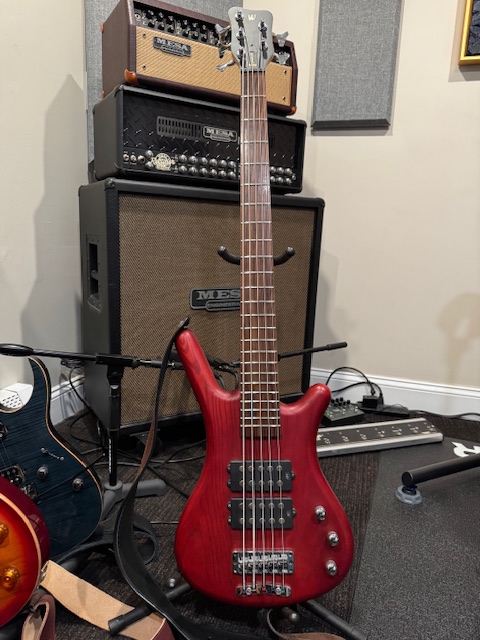
It also sounds great in full humbucker mode, but I’ve always liked the grittiness and attack of singlecoils on a bass (one of these days I want to grab a good 5-string J-Bass, though this Warwick sounds good enough, and plays well enough, that it’s not pressing), and if anything it sounds a little TOO huge, to me. Humbuckers give you this huge, thunderous low end – split coils have a little more of a “rock” attack to them.
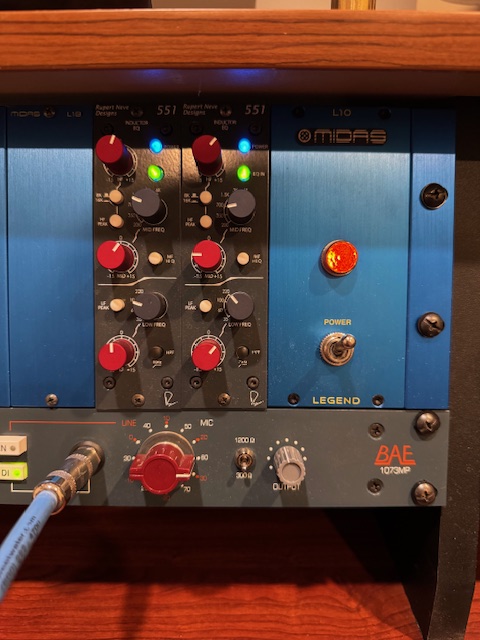
I’m running the Warwick into the DI input of a BAE 1073MP run pretty hot, and from there into a Neve 551 set for a bit of a boost at 220hz, a moderate cut at 350hz, and then a slight high end boost at 8khz. For the demos I replicated this approach loosely using Satson’s Burnley73 Neve EQ/saturation emulator, and honestly that sounded pretty great too. Zero Mantra, I did the metal bi-amp thing, low passing around probably 250-400 and compressing the hell out of one track, and then high passing around 600 and distorting another, out of a Sansamp preamp, I think. I’m not doing that here, though if you look at the EQ points, spiritually it’s coming from a very similar place. It’s possible in the final mix I’ll duplicate these tracks and do some sort of high passed high end amp simulated or reamped tone here as I work on this, blended in a little to give it some more high end growl and bite. But, for a couple of years now while writing for this album I’ve just been doing this, and have been very happy with the low end of my recordings. Honestly, I’m not all that metal, and distorted bass even on heavier songs has seemed less and less important for making a performance “gel” than getting a good solid bass tone, which this does.
This is a quick -bass-into-preamp/EQ-into computer clip from one of the songs, with drums for now just run in Superior 3’s “Ninety One” (Nevermind, I assume) preset for now:
Very end of the verse, into the pre-chorus. Nothing else on the bass here than what it sees on input, some compression and a little more EQ (my thinking here is get it most of the way to where I want it on input, but then fine tune it in the box) would go a long way, but I’ll worry about that when I’m done tracking.
When all’s said and done the bass will probably take a little bit of slip-editing to get 100% in the pocket; for me lead guitars are one thing, they’re pretty much what you see is what you get, and I don’t want to touch them. But, as a guitarist with a bass rather than a bassist, no one will ever listen to this recording because of the bass playing (and likely almost no one will anyway!), and really being locked into the drums makes everything else sound better.
So, two tracks of bass down, six to go.
UPDATE on March 19th, 2025:
It occurred to me that one thing this post could really use, beyond a description of what I was using, was audio and video of the various pieces. So, here we are:
Couple comments on this, beyond what I say on the video: more than anything else in this whole process, getting a clean recording of a good performance is going to get you 99% of the way there. The differences we’re talking about here are extremely small, and this is basically just the iterative process of taking something that’s already sounding great, and making it a little bit better. I’m very happy with the sound I’m tracking, but I could also just as easily be recording the straight DI and using a Neve-style EQ for this sound (and, for the demoing, for the most part that’s exactly what I did, with the Sonimus Burnley73 carrying the weight for the BAE and Neve). You can go pretty deep down this rabbit hole, and sometimes that’s a fun process, but the point where it starts to become more frustrating than fun, then just take a step back and focus on the big picture. Is your bass in tune, and set up with fresh strings? No notes are choking or buzzing? Are you clipping anywhere in your signal chain? And is your performance as good as you can get it? If you can answer yes to all of those, then even pretty simple, basic signalchains are going to get you well on the way to making great sounding music.
 Drew Peterson