When I was starting to think about how I wanted this album to sound, when I was writing it, I’d kind of expected that there would be a lot more acoustuc rhythm guitar than there actually was. As it happens, two of the nine songs have acoustic guitar parts – the one I’m adding at the last second and hoping it all comes together, and one that was originally written on an acoustic, demoed on an electric, and then at the last second I ended up going back and adding an acoustic rhythm figure after all. Go figure. Anyway, acoustic guitars are done. My fretting hand fingertips are numb, I’d thought bass would better prepare me here, but no.
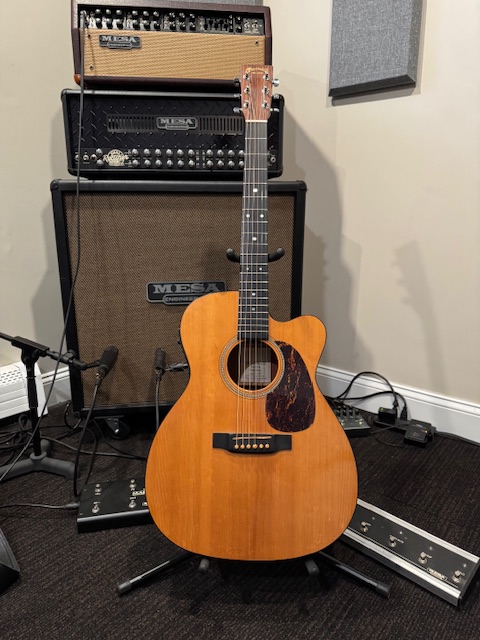
My acoustic guitar is a Martin MC16-GTE, from 1997 that I bought used in 2004, I think. I wasn’t in the market for an acoustic but had just got my first real post college job paycheck and happened to be in the acoustic section of my old local guitar shop, and in between the Taylors they had a used Martin. I picked it up, the longer I played it the more it stopped sounding “restrained” compared to the Taylors and started sounding “balanced,” and next thing you know, well, I made it as far as the parking lot before I turned around, walked back in, and bought it.
The acoustic rhythm guitars here are recorded as two mono tracks, panned left and right. I remember when I was first learning how to record spending hours on the internet reading about how to record acoustic guitars in stereo, and that seemed amazingly complex, therefore very important to learn, and just what one does when recording acoustic guitars. I’ll have to go back and check the Zero Mantra project files, but I’m almost sure that’s what I did recording that (with this same guitar, more than ten years ago).
Over time, I gradually had a change of heart here. Stereo acoustic recordings make a lot of sense when you’re recording a single performance and you want to make as big as possible. Solo acoustic guitar, or acoustic singer songwriter with minimal accompaniment; you probably have one performance but you need both size and stereo spread. In a rock context, though, your problem is exactly the opposite – you want stereo spread, but you’re going to have to fit your guitar in around a lot of other stuff, and space is a priority since everything else is fighting for it. At some point, I just started using one mic at a time and double-tracking instead, and never really looked back.
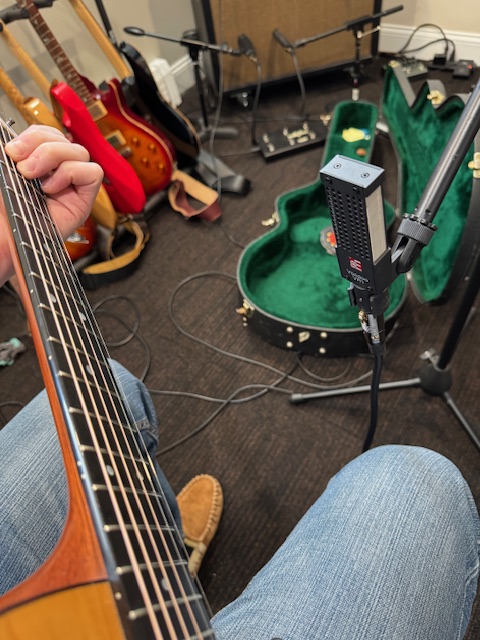
I did some experimenting before tracking and ended up changing up my expected mic approach here – I have a sE Electronics Voodoo VR1 that I’d originally bought partly to have a good ribbon option and partly because I’d heard some really killer rhythm guitars cut with one, and I’d never really spent much time with it on acoustic. As it turns out, I loved it. It’s very rich, full, and balanced sounding, while still having good detail. So, one of the two tracks was the VR1, pointed at the 12th fret or so, fairly close but not so close it got in the way.
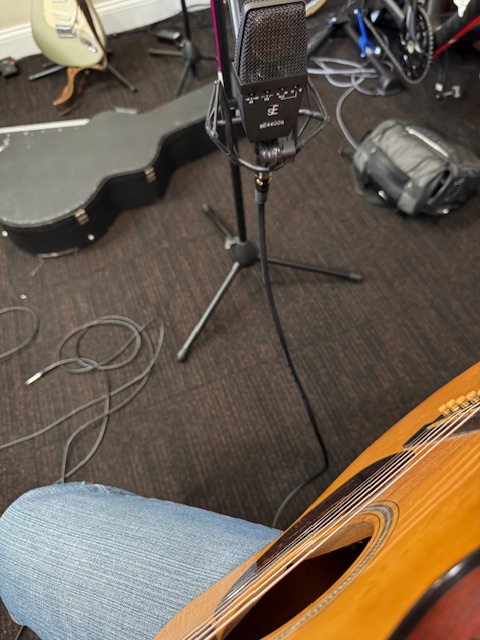
The second mic was the one I’d planned on using all along, a sE Electronics sE4400a, their take on a C414 brass capsule large diaphragm condenser, and a mic I was so impressed with that I decided to try their ribbon, as well. This one, to compliment the ribbon, I had positioned at the bridge, which gives you both a darker, thicker sound… but also much more of the pick attack and “strum” sound. They combine into something pretty cool.
Ribbon:
Condenser:
Combined:
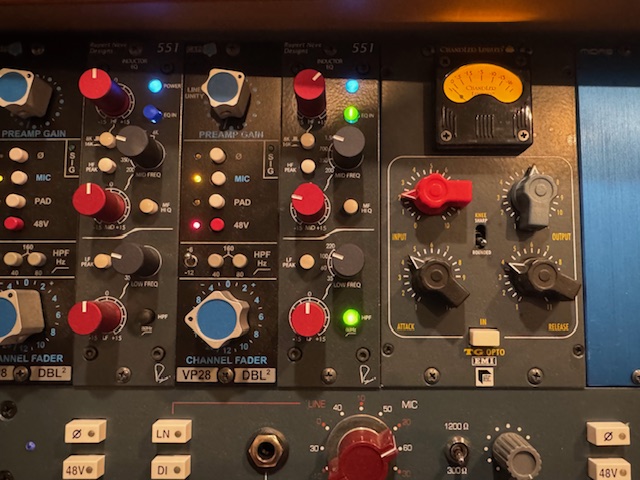
These are raw tracks, nothing else added to them. They were recorded through a CAPI VP28 API-style preamp, and then again with a Neve 551, taking out a little midrange at 700hz and slightly boosting the treble at 8k. I then ran them into a Chandler TG Opto compressor – I love the sound of an opto compressor on acoustics, and especially when it’s audibly pumping a hair. I’m probably painting myself into a corner a little bit here, but it does help everything gel in a mix a little.
I also did a video walking through some of this stuff:
…with some different audio clips, and going through my signal chain adding things in piece by piece. I’m not going to claim that this is the greatest acoustic guitar tone ever recorded – that’s probably Travis Meeks on really any of the Days of the New albums – but it’s one I’m pretty happy with and I think will work well for what I’m envisioning for the mix around it.
Anyway, acoustic guitars are done. Time to move on to clean electric rhythm guitars.
 Drew Peterson