
This is an update that’s now a couple weeks late – it was a busy few weeks personally, but I’ve also been working on the mixing and the track preparation (cutting out excess dead space before a part comes in, roughing in pan level and and routing, all that fun stuff) so I haven’t really had the time to sit down in front of a computer and write about the process of tracking guitar tones. But, I need to, so here we are.
First, as a general observation… I didn’t expect to have as much fun doing this as I did. I’m not going to oversell it, tracking an album’s worth of guitar tones, in two marathon blocks, is a lot of work, and it has the potential to be tedious, as well. But, oddly, this is something I really enjoy. I think there’s a certain amount of pleasure in putting aside all distractions and doing anything to the limit of your ability, but this in particular was something where, midafternoon on Friday, the second day of work, as I was coming into the last couple songs, it ocurred to me I probably was living my best life here. In another world, if there was still any money inn this, I suspect I might have thrived as a recording engineer.
Anyway, I did a lot of experimenting with different mics and positions up front, but ultimately this album was tracked the way I expected it to be; with a Shure SM57 and Sennheiser MD421, both on a single speaker of my Rectifier Traditional 4×12. While both were ultimately tracked at loosely the same level (same preamp gain settings, and while the trim isn’t indented in the same way gain is, visually the same trim settings) and very well may remain so in the final mix, I tend to think in terms of a “primary” mic and a “supporting” mic when micing a cab.
For me, the SM57 is a no-brainer for a “primary” cab mic. It’s not one of the flattest options out there, with a drop-off below 200hz (and about-5db at 100hz), a very slight dip between 300-700hz, and then a bit of a presence hump between 2khz and 11khz peaking around 6-8khz. From there, it falls off pretty rapidly, around 12khz and above. But, this is a profile that captures most of what you want in a distorted guitar tone, and not much of what you don’t. Frequency chart, courtesy of Shure:
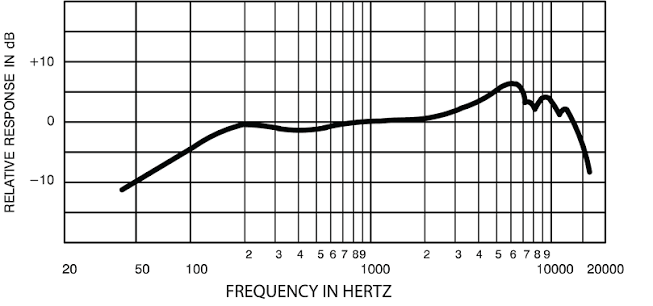
The 50-100hz range isn’t exactly meaningless for a guitar (in E standard your fundamental is 80hz), but sub-100hz is also where you’re going to get the most pronounced proximity effect from close-micing a source, so this roll off naturally counters some of the proximity effect inherent in a mic designed for close-mic’d applications. Meanwhile, the actually reduction here is extremely subtle, but 400-750hz or so is a common point to scoop rhythm guitars to remove some of the “cardboard” sound, and a lot of the “crunch” sound in a guitar is happening in the 6-8khz range, right around the peak for a SM57. It’s a mic I hated for a long time before I realized that a lot of the things I didn’t like about it on a guitar in isolation worked really, really well in a mix (and, I suspect, there was a learning curve I was still working my way along).
The MD421 meanwhile, is a lot closer to being flat in the low to midrange:

There’s still a slight frequency roll off (again, very helpful in close-micing applications) but its ruler flat between 90hz and 1khz. Above that, however, it has a fairly pronounced high end boost, centered between 4-6khz, and modestly boosted out through 15khz, before dropping off pretty sharply from there. The effect is when you audition the mics in as comparable positions as you can put them, the MD421 sounds almost a little scooped, thanks to its higher highs and lower lows. It’s a natural if you want a second mic to sit “around” a SM57.
And, I do think, as good as a SM57 is (and my first album was all SM57, alone), it’s a very “filtered” sound, where you build a veery narrow “window” where you can see your guitar sound through it. A second mic adds a lot of dimension, Everything seems broader, more three-dimensional, lusher… which isn’t always the answer, but I’m a guitarist making instrumental guitar music, and if I’m going to go all-in on anything, it’s going to be the size of my guitar tones.
I did a video walking through positioning the two, here:
The upshot is, phase alignment is critical when using two mics on the same source, whatever that source is. The way I approach this is, position my first mic to sound as good as I possibly can get it on its own. Then, sort of ballpark the second mic going for a tone I think will compliment the first (generally, darker and bringing a bit more depth). Next, flip the second mic out of phase with the first (either using an external preamp, or monitoring through your DAW), bring both mics up to the same volume, and, leaving the first mic unchanged, slowly adjust the position on your second until it sounds as bad as you can positively make it sound. Thin, washed out, harsh… picture the opposite of your perfect guitar tone, and shoot for that.
Then, when you have something truly terrible sounding… go back to your DAW, and flip phase on your second mic. Magic.
Anyway, on to the reamping process. Here’s a slide show of some behind the scenes pictures:
…and a few YouTube shorts I posted while working:
The signal chain here was the two aforementioned mics, into a BAE 1073DMP, run through a pair of Neve 551 EQs. For the most part all of the lead tracks were recorded with no EQ and the rhythm tracks with about a -6db cut at 700hz, though I kept meticulous notes of amp settings and preamp/EQ adjustments from track to track. Amp-wise, almost all of the lead tones werte my Mark V in IV mode (with a few supporting parts in Edge), and almost all of the rhythm tracks were my Roadster. I also used a BYOC TS808 build on a couple tracks in front of the Roadster; I don’t always love the “boosted Recto” sound, but it’s a modern classic for a reason and there were a couple points where I thought it was appropriate.


On thing I was worried about coming into this; before parenthood, I’d always shied away from reamping (or, VST-based modeling, for that matter) for fear of analysis-paralysis; mixing is enough of a slog as it is, and I was worried if I had thre ability to go back and fundamentally reshape my guitar sounds at some point along the way, I might drive myself crazy by redoing my guitar sounds over and over again. I’m not going to say it was two days and done… but I found that wasn’t the case here. It may be I underestimated how much work reamping an entire album was (I did this across two days, taking the days off work to focus; Thursday and Friday, 6/11-12. Thursday was probably 12 hours of tracking, and Friday I wrapped up by midafternoon so call it another 6), but I also just spent a lot of time up front making sure I was really getting the tones I wanted.
There were a handful of things I went back after a couple days to redo:
*One rhythm part on “Taking Flight,” a clean figure that comes in right before the outro, I just plain missed.
*the clean toned part for “First Light,” in hindsight, I’d chosen a sound that sounded good in the room but was too bright and gritty recorded
*the song that I’m still searching for the right name for that’s structured as an Andy Timmons-like power trio arrangement, I ended up doubling the lead/melody part with my Roadster set for a lead sound in Ch 3 Vintage, to give the Mark V in IV mode a little more hair and grunt to the low end, and blended the two parts.
There was one other song where I wanted to try a lower gain sound from my Strat, and ended up keeping the original tracks. And, the outro to “At the Top of my Lungs,” while hashing out a rough mix, there were some intonation issues that weren’t sitting well with me, so I just re-recorded the guitar part and reamped the leads with the same settings as before. That’s it, though, and while cleaning my room the other night I nudged one of my mics, so these are now keeper tones.
At present, I’m working through “At the Top of my Lungs” as mind of a mixing test case for the rest of the album. Just with an eye on getting this out the door, I’d started to give consideration to just using the Superior 3 preset I’d tracked with, but told myself I’d give myself two days to tackle the mix and see if I could come up with a better drum sound. And, sure enough, I did, so as that gets closer and closer to where I want it to, I’m starting to take those moves and apply them to the remaining songs, as a jumping off point for anything song-specific I may want to do.
One encouraging sign, though, that I’ve done the necessary work up front in the writing, arranging, and tracking, was on Friday night, I stayed up late into the night doing all the necessary prep work before mixing (trimming excess silence, etc) and setting pan and volume, and doing some volume automation where it was necessary (though I think I have more to do). And even that, with a very rough first-pass on the bass and the Superior presets I was using while tracking, and just throwing a send on the lead tracks into a delay bus… even that already sounded pretty good.