This is a very quick post, since I haven’t said much about this project in a while. First, lately I’ve mostly been mixing, and latly not much of that – I’ve had some sort of viral extreme head cold type of thing lately that amongst other things has severely messed with my hearing. My ears are only just starting to unplug now, and every time they do it’s like the world suddenly has a subwoofer; my low end perception was basically gone, and high end was kind of painful, actually, from the congestion. No fun at all.
But, while I’m pretty happy with how most of the raw tracks sound, at my mastering engineer’s suggestion (after sending him an early mix for feedback) I retracked the “heavy” Rectifier sounds. The combo of a SM57 and MD421 balanced pretty equally worked very well for lead sounds, but gave me a heavy rhythm tone with a lot of high end to it. He also thought too much of the room sound was bleeding in, My SM57 had gotten nudged somewhere along the way after I’d finished tracking so I had to reposition this from scratch and chose a slightly differnt point, and then I swapped the MD421 for my sE Electronics Voodoo VR1 ribbon. I also tried encasing my cab in heavy foam cushions – this is a Nugget set for my daughter to play with, and it actually works pretty well as acoustic material (more on that later, but his suggestion was if you can breathe through it even with difficulty, it’s not reflecting sound waves but allowing them to pass through and be deadened, and sure enough…)
Rather than a picture of the isolated cab, here’s a YouTube Short:
The results were… fair. Going back and forth between a bus with the new tracks and a bus with the old ones, ultimately I preferred the old ones; I’m not 100% sure why but my working theory is they didn’t “sit” in the same space as everything else, and I think what my ear was responding to was the change in position of the SM57, and it was picking up a slightly but audibly different “image” of the cab.
I was about to scrap them all and just work around the old tracks, but then on a whim I tried pulling just the VR1 track in with the prior SM57 and MD421. By rights, this should NOT work; the 57 and 421 were carefully phase aligned with each other during the original tracking session, an while I was careful in the way I positioned the VR1 with respect to the SM57 in the second session, the 57 wasn’t in exactly the same place so it should have been a phase nightmare. And yet, somehow, it dropped in perfectly. I don’t know if it’s the ribbon just has a larger pickup area and larger sweet spot, or by some infinitesimally small probability I happened to place the VR1 at the exact right position to work well with the other two mics or what. But, the two (57/421 and 57/VR1) busses sounded bad together, the secobnd 57 sounded bad when added to the 57/421 bus… but the VR1 dropped in perfectly. I sent the results over to my mastering engineer who when I first told him what I’d done patiently explained I was adding in too many unknown phase variables (which is absolutely true), and then he hit play and wrote back “oh, that does sound better, somehow.”
So, for anyone reading this, I would NOT recommend adding an additional mic track in a second session weeks later when you don’t have the first two mics also running top carefully balance position with, and this is all the result of an improbable amount of dumb luck that feels pretty unrepeatable. But, I think if I were to do this again starting from scratch, I would probably continue using a 421 as a second mic for lead tracks, but swap it out for the VR1 while maintaining the same 57 position for rhythm and, probably, clean tracks (the clean rhythm tracks I’m either using all SM57 or a 57 with very little 421 added, in the mix, depending on whatever sounds best to me in context). At some point I’ll do a summary post of lessons I’ve learned in this project, and that’s going to be one of them.
The other retracking I did, honestly, was out of my hands. I had my dad’s acoustic, a 1965 smallbodied Gibson, for a couple weeks, bookending a stint at an excellent local acoustic shop that also specializes in repairs on vintage instruments. This was the guitar that decades ago my dad learned how to play on, and when I first picked up the guitar (also decades ago, now), this was the one I learned on to. It’s just a great sounding guitar, but it’s also one that I have a huge sentimental attachment to, and since I had it I wanted to stick it somewhere on the album. So, since the acoustic opening to the Gm riff track had some raspiness to it thanks to the top of a pick starting to tear a little while tracking that I didn’t notice until I was done, and since the dynamics of the performance felt a little too immediately “on” to me, I figured I’d recut that. I’m happier with the part now, for musical and personal reasons both. I didn’t happen to shoot any footage of cutting the part, but I did record some improvisation on the guitar with a couple hastily placed mics after the fact:
It’s just such a cool guitar; I’m glad it’s somewhere on this album, even if it now means my Collings isn’t.
Then, as a final update; since those Nugget cushions were actually pretty effective at acoustic control, and since my room is too “live” sounding and I’ve had a hard time assessing ambience in the mix, a friend suggested I try this:
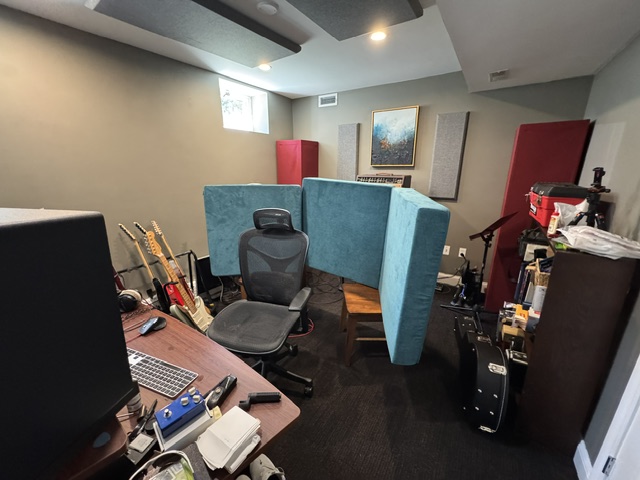
The mixes are coming along, and I think I can finally hear well enough that I trust my ears again; before getting sick I spent a lot of time working on the low end and in particular getting some more dynamics out of the bass, which I’m afraid I’d basically turned to steady state low end via parallel compression. The last full round of mixes before I lost faith in my ability to assess anything, I think things sounded pretty good but all the rhythm tracks were too low, so I’m working on fixing that now.